How to Estimate Asphalt and Bitumen for 1 km Road?
Table of Contents
ToggleIntroduction
Bitumen quantity for a 1 km road depends on the road width, pavement thickness, asphalt density, and the bitumen content of the mix. Estimating the bitumen quantity and the asphalt required helps with material planning, cost estimates, and avoiding shortages or excess. A road may also contain different layers, such as a wearing course and binder course, and each must be calculated separately. In this guide, you’ll see how to estimate bitumen quantity and asphalt for a 1 km road using a simple worked example, what can change the final estimate, and how a bitumen calculator can speed things up.
Assumptions for the Bitumen Quantity Example
To estimate the asphalt and bitumen required, we’ll use a simple 1 km road example. Assume the road is 7 meters wide and has two asphalt layers: a 50 mm wearing course and a 75 mm binder course. For the calculations, we’ll use an average asphalt density of 2,400 kg/m³ and a bitumen content of 5% in the asphalt mix.
(Note: These values are only for the worked example. Actual road projects can use different layer thicknesses, mix designs, densities, and bitumen contents based on the project specifications.)
Calculate Asphalt Quantity for 1 km Road
To estimate the asphalt required for a 1 km road, we will calculate the volume and weight of each asphalt layer separately. We’ll use the assumptions above and start with the wearing course, followed by the binder course.
Wearing Course Calculation
Step 1: Convert the road length
The road is 1 km long.
1 km = 1,000 meters
Step 2: Convert the layer thickness
The wearing course is 50 mm thick.
50 mm = 0.05 m
Step 3: Calculate the asphalt volume
Use the formula:
Asphalt Volume = Length × Width × Thickness
= 1,000 × 7 × 0.05
= 350 m³
So, the wearing course requires 350 m³ of asphalt.
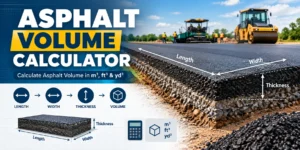
Once the road dimensions and pavement thickness are known, the asphalt volume can be calculated. For other project dimensions, you can also use our asphalt volume calculator.
Step 4: Convert volume into weight
Using the assumed asphalt density of 2,400 kg/m³
Asphalt Weight = Volume × Density
= 350 × 2,400
= 840,000 kg
= 840 tons
Therefore, the estimated wearing course quantity is 350 m³, or about 840 tons of asphalt.
Binder Course Calculation
Now repeat the same process for the 75 mm binder course.
Step 1: Convert the thickness
75 mm = 0.075 m
Step 2: Calculate the asphalt volume
Asphalt volume = 1,000 × 7 × 0.075
= 525 m³
So, the binder course requires 525 m³ of asphalt.
Step 3: Calculate the asphalt weight
Asphalt weight = 525 × 2,400
= 1,260,000 kg
= 1,260 tons
Therefore, the estimated binder course quantity is 525 m³, or about 1,260 tons of asphalt.
Total Asphalt Quantity
Now add both layers:
Total volume = 350 + 525 = 875 m³
Total weight = 840 + 1,260 = 2,100 tons
So, based on these assumptions, a 1 km road would require approximately 875 m³ or 2,100 tons of asphalt mix for the wearing and binder courses.
Calculate Bitumen Quantity for the Road (already good, keep it)
The amount of bitumen depends on the bitumen content specified for the asphalt mix. In our example, we are using a 5% bitumen content. This means that 5% of the total asphalt mix weight is bitumen.
Step 1: Find the Total Asphalt Weight
From the previous calculation, the wearing and binder courses together require:
840 tons + 1,260 tons = 2,100 tons of asphalt mix
Step 2: Apply the Bitumen Percentage
Use the formula:
Bitumen Quantity = Total Asphalt Weight × Bitumen Content ÷ 100
Substituting our values:
= 2,100 × 5 ÷ 100
= 105 tons
Step 3: Convert to Kilograms
Since 1 tons = 1,000 kg:
105 × 1,000 = 105,000 kg
So, the estimated bitumen quantity for the road is 105 tons, or 105,000 kg.
(Note: This is an estimate based on the assumed 5% bitumen content. The actual requirement can vary according to the approved asphalt mix design and project specifications.)
Estimated Asphalt and Bitumen Requirements for 1 km Road
| Road layer | Thickness | Asphalt volume | Asphalt weight |
| Wearing course | 50 mm | 350 m³ | 840 tons |
| Binder course | 75 mm | 525 m³ | 1,260 tons |
| Total | – | 875 m³ | 2,100 tons |
What Can Change the Bitumen Quantity?
The quantities above are based on a few assumptions. Your actual bitumen quantity for road construction may differ if the road design, materials, or mix are different. Key factors include:
- Road width: A wider road requires more asphalt and bitumen for the same length.
- Layer thickness: Thicker wearing or binder courses increase the total material required.
- Asphalt density: Different mixes can have different densities, affecting the weight calculated from a given volume.
- Bitumen content: A mix containing 4% bitumen will require less bitumen than one containing 5% or 6%.
- Material wastage: Handling, transportation, and construction losses may increase the amount of material that needs to be ordered.
- Road layers: Additional layers or treatments, such as prime and tack coats, can add to the overall bitumen requirement.
Because of these variables, the 1 km example provides an estimate, not a fixed quantity for every road project.
Asphalt vs. Bitumen: What Are You Actually Ordering?
When estimating materials for road construction, it is important to distinguish between asphalt mix and bitumen. Asphalt mix is the finished paving material made from aggregates and bitumen. While bitumen acts as the binder that holds the materials together.
For example, our calculation gives 2,100 tons of asphalt mix for the two road layers. With a bitumen content of 5%, only 105 tons of that total is bitumen. Therefore, if a supplier is providing ready-made asphalt mix, you would generally order the required quantity of asphalt mix, not 2,100 tons of bitumen. If you are buying bitumen separately, you would need about 105 tons, based on the 5% bitumen content used in this example. This distinction helps prevent a major ordering mistake, the asphalt quantity and bitumen quantity are not interchangeable.
Tack, Prime and Seal Coat Requirements
Bitumen isn’t only used in asphalt layers. Road construction can also involve tack coats, prime coats, and seal coats, depending on the pavement design and surface being treated.
Tack coat
A thin layer of bituminous material applied between pavement layers to help them bond.
Prime coat
Applied to a prepared granular base before the asphalt layer to seal and prepare the surface.
Seal coat
A surface treatment used to protect the pavement and help seal small surface openings.
These treatments are usually calculated based on the area being covered and the specified application rate, rather than as a percentage of the asphalt mix. Therefore, they should be estimated separately when they are included in the project design.
Use a Bitumen Calculator to Check Bitumen Quantity
Calculating bitumen requirements manually can take time. A bitumen calculator can make the process quicker by using the relevant road measurements and material details to estimate the required quantity. It is useful for checking different road widths, layer thicknesses, and bitumen percentages without repeating the calculations manually.
FAQs
- How much bitumen is required for 1 km of road?
The amount depends on the road width, asphalt thickness, mix density, and bitumen content. For the example in this guide, the estimated requirement is 105 tons of bitumen.
- How do you calculate bitumen quantity for road construction?
Bitumen quantity can be estimated by multiplying the total asphalt mix weight by the specified bitumen content percentage. The required percentage depends on the asphalt mix design.
- How much asphalt is needed for 1 km of road?
There is no single fixed quantity because it depends on the road dimensions and layer thickness. A wider or thicker road will require more asphalt.
- What is the difference between asphalt and bitumen?
Bitumen is the binder, while asphalt mix contains bitumen combined with aggregates and other materials. They are therefore not the same quantity.
- Can a bitumen calculator estimate the quantity for a 1 km road?
Yes. A bitumen calculator can provide a quick estimate when you enter the required road dimensions and material information. For construction, the result should be checked against the project’s specifications.
Conclusion
Estimating the bitumen quantity for road construction becomes easier when the road dimensions, layer thickness, asphalt density, and bitumen content are known. For a 1 km road, calculating each layer separately gives a clearer estimate and helps with material planning. A bitumen calculator can also make these calculations quicker when project measurements change.
Want to check your own road? Use the free Bitumen Calculator.

Written by Hassan Ijaz
Hassan Ijaz writes practical, engineering-grounded guides on pavement materials, bitumen, and asphalt to help builders and engineers make informed decisions.
More about CalcPave →