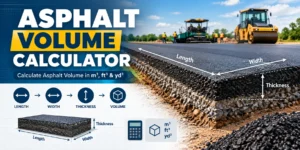
Asphalt Weight Calculator
Table of Contents
ToggleIntroduction
When ordering asphalt for a paving project, knowing the required amount can help you avoid unnecessary costs and material waste. But how do you know how much asphalt you actually need? An asphalt weight calculator estimates weight using the asphalt’s volume and density. It helps determine the total asphalt weight for a specific project, whether you are paving a driveway, road, or parking area. Understanding the asphalt weight per cubic meter also makes it easier to estimate how much material is required before placing an order. With the right measurements and asphalt density, you can calculate the approximate weight and plan your project more accurately.
What Is an Asphalt Weight Calculator?
An asphalt weight calculator is a tool that estimates how much asphalt is required for a specific paving project. It uses a few basic measurements to calculate the asphalt weight. You typically need to enter the length, width, and thickness of the area. The calculator also uses the density of the asphalt mix because different mixes can have different weights.
Once these values are entered, the calculator determines the asphalt volume and converts it into an estimated weight, usually in kilograms or tones. This is different from calculating asphalt volume, which tells you how much space the material occupies. Understanding both measurements gives you a clearer picture of the material needed for your project. If you also need to estimate the binder component of an asphalt mixture, you can use our Bitumen Calculator.
How to Calculate Asphalt Weight
To calculate asphalt weight, you need the asphalt volume and density. Follow these three steps to calculate the total weight of asphalt. Asphalt weight calculations estimate the total mass of the mixture, while the amount of binder within that mixture can be estimated separately. Learn more about how to calculate bitumen content.
Step 1: Calculate Asphalt Volume
First, calculate the volume of asphalt needed. Multiply the length, width, and thickness of the area. Make sure all measurements use the same unit, such as meters. Volume = Length × Width × Thickness.
Step 2: Determine Asphalt Density
Next, find the density of the asphalt mix you’re working with. Typical asphalt density is often around 2,300–2,500 kg/m³ although the exact figure depends on the mix. Always use the density listed for your specific material. For a more detailed explanation of density values and their role in pavement material calculations, see our Asphalt Density Calculator
Step 3: Calculate Asphalt Weight
Finally, multiply the asphalt volume by its density. Asphalt Weight = Volume × Density Example: Suppose an area is 10 meters long, 4 meters wide, and requires 0.05 meters of asphalt. The volume is: 10 × 4 × 0.05 = 2 m³ Using a density of 2,400 kg/m³: 2 × 2,400 = 4,800 kg Therefore, the estimated asphalt weight is 4,800 kg, or 4.8 tones.
Asphalt Weight Formula
The asphalt weight formula connects the material’s volume with its density to find its total weight: Asphalt Weight = Asphalt Volume × Asphalt Density.
The units must match for the calculation to work correctly. If volume is measured in cubic meters (m³) and density in kilograms per cubic meter (kg/m³), the result will be in kilograms (kg). To convert the result into tones, divide the weight by 1,000.
The units must match for the calculation to work correctly. If volume is measured in cubic meters (m³) and density in kilograms per cubic meter (kg/m³), the result will be in kilograms (kg). To convert kilograms to tones, divide the result by 1,000. Keeping the units consistent helps an asphalt weight calculator produce a clear and usable result.
Asphalt Weight per Cubic Meter
How much does a cubic meter of asphalt weigh? The answer depends on the type of mix and its density. One cubic meter does not always have the same weight because asphalt mixes contain different aggregates, binders, and air voids. As a result, the asphalt weight per cubic meter can vary from one mix to another.
Asphalt Type/Mix | Typical Density | Approx. Weight per m³ |
Hot Mix Asphalt (HMA) | 2,300–2,500 kg/m³ | 2,300–2,500 kg |
Warm Mix Asphalt (WMA) | 2,200–2,400 kg/m³ | 2,200–2,400 kg |
Cold Mix Asphalt | 2,000–2,300 kg/m³ | 2,000–2,300 kg |
(Note: Actual asphalt weight may vary based on the asphalt mix, aggregate type, and compaction. Use the specified mix density for a more accurate estimate.)
Factors Affecting Asphalt Weight
Why can two batches of asphalt with the same volume have different weights? The answer lies in the materials used and how the asphalt is prepared and placed. Several factors can influence the final result.
Asphalt Mix
Different asphalt mixes contain varying amounts of binder, aggregates, and other materials, which can affect their overall composition and density. As a result, each mix can have different characteristics and may weigh differently even when the same volume is used. Different asphalt mixes contain varying amounts of binder and aggregates. If you’re unsure about the difference between these materials, see our guide on Bitumen vs Asphalt.
Density
The amount of material packed into a specific volume affects how heavy the asphalt will be. A mix with higher density contains more material in the same space, so it generally weighs more than a less-dense mix of the same volume.
Thickness
The depth of the asphalt layer directly affects how much material is needed for a project. A greater layer depth means more asphalt is used across the same surface area, which increases the overall amount and weight of the material.
Moisture
Water present in the asphalt mixture can add to its measured weight, especially before the material is fully processed or dried. The impact depends on how much moisture is contained within the mix at the time of measurement.
Compaction
The way asphalt is compacted can affect how much material fits within a given space. Proper compaction reduces air gaps between the particles, allowing the mix to become more tightly packed and potentially increasing its weight for the same volume
Aggregate Composition
Aggregates make up most of an asphalt mix and can vary in type, size, and proportion. These differences affect how the particles fit together within the mix, which can influence its overall characteristics and weight.
FAQs
1. How much does 1 cubic meter of asphalt weigh?
Typical asphalt weight varies by mix density. Multiply the volume of 1 m³ by the density specified for the asphalt mix. Your article currently presents typical ranges of approximately 2,000–2,500 kg/m³ depending on the mix.
2. How do you calculate asphalt weight?
Calculate the asphalt volume by multiplying length × width × thickness. Then multiply the volume by the asphalt density: Asphalt Weight = Length × Width × Thickness × Density.
3. What is the asphalt weight formula?
The basic formula is:
Asphalt Weight = Volume × Density
If the dimensions are known:
4. How many tones of asphalt do I need?
First calculate the asphalt weight in kilograms. Then divide by 1,000:
Tons = Kilograms ÷ 1,000
5. How much does asphalt weigh per square meter?
The answer depends mainly on thickness and density. Calculate it by multiplying asphalt thickness in meters by density in kg/m³.
6. What density should I use for asphalt?
Use the density specified for your particular asphalt mix whenever possible. Different mixes can have different densities due to their aggregate composition, binder content, and air voids.
7. Is asphalt measured in tones or cubic meters?
Both units are used. Cubic meters measure asphalt volume, while tones measure asphalt weight.
8. How do I convert asphalt weight from kilograms to tones?
Divide kilograms by 1,000.
9. Does asphalt thickness affect the required weight?
Yes. Increasing the thickness increases the asphalt volume, which increases the total weight required.
10. Can I calculate asphalt weight for a driveway?
Yes. Measure the driveway’s length, width, and required thickness, then multiply the resulting volume by the density of the asphalt mix.
11. Why does asphalt weight vary?
Asphalt weight can vary because of differences in density, aggregate composition, mix design, moisture, and compaction.
12. How accurate is an asphalt weight calculator?
The result is an estimate based on the measurements and density entered. Accuracy depends on using correct project dimensions and an appropriate density for the specific asphalt mix.
Conclusion
Estimating asphalt requirements does not have to be complicated. An asphalt weight calculator gives you a quick starting point for understanding how much material your project may require. It can help you make better decisions when ordering asphalt and preparing for delivery. Keep in mind that results are estimates, so the actual asphalt weight can vary depending on the mix and site conditions. For larger projects, checking the supplier’s specifications can provide a more dependable figure. With a reliable estimate in hand, you can plan your asphalt needs with greater confidence.
Need a faster estimate? Use the CalcPave Asphalt Weight Calculator to calculate asphalt volume, weight and approximate tones for your paving project.

Written by Hassan Ijaz
Hassan Ijaz writes practical, engineering-grounded guides on pavement materials, bitumen, and asphalt to help builders and engineers make informed decisions.
More about CalcPave →